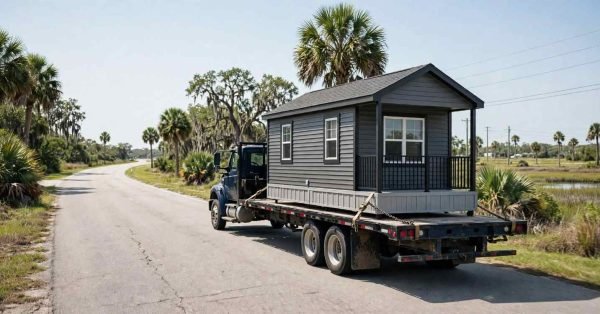
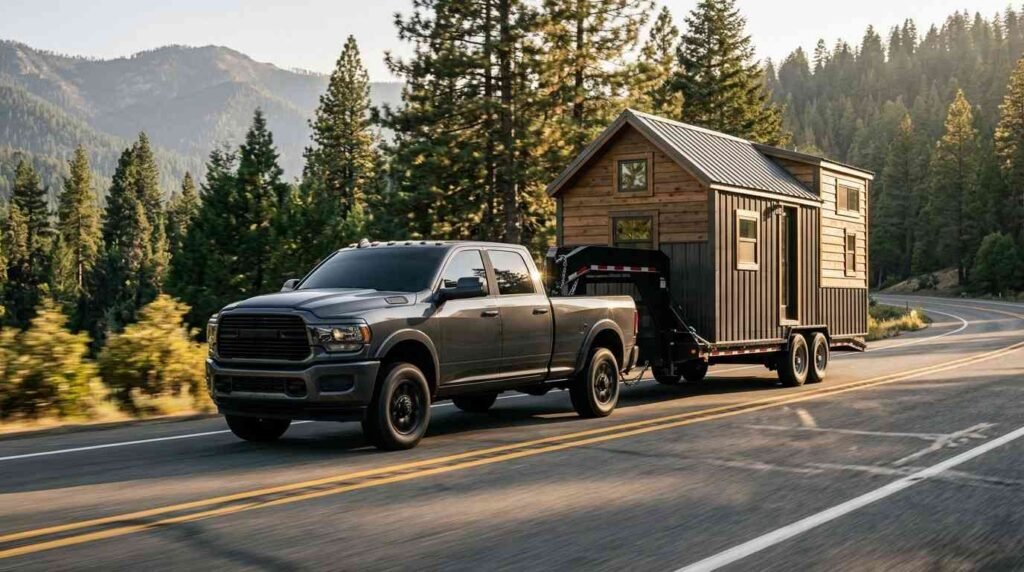
A tiny house on wheels typically weighs between 10,000 and 15,000 pounds fully loaded, which determines nearly every towing decision you’ll make. I’ve watched too many new owners buy a beautiful tiny home and only then discover their truck can’t legally or safely pull it. That backward sequence causes most of the stress people associate with tiny house ownership.
Towing mistakes damage trailers, void warranties, and create real safety risk on the road. Getting the weight, truck, and legal pieces right before you ever hitch up changes everything.
This guide covers how much a tiny house actually weighs and why that number drives every other decision, what truck and hitch setup matches that weight, the braking and safety systems that keep a loaded trailer stable, and the Florida-specific laws, licensing, and driving practices that keep your tow legal and uneventful.
How Much Does a Tiny House Weigh?

A fully loaded tiny house on wheels usually weighs between 10,000 and 15,000 pounds, depending on size and materials. That figure includes the trailer frame, the structure built on top of it, appliances, furniture, and water in the tanks. I always tell people to stop thinking in square feet and start thinking in pounds, because pounds are what your truck actually has to move.
Dry weight is the trailer as it left the builder, before anyone added furniture or filled a water tank. Loaded weight, often listed as Gross Vehicle Weight Rating, adds everything you’ll actually carry day to day. A 20-foot tiny house commonly lands near 10,000 pounds loaded, while a 30-foot unit with full appliances and a loft addition can approach 15,000 pounds or more.
| Tiny House Length | Typical Dry Weight | Typical Loaded (GVWR) |
| 20 feet | 7,000–8,500 lbs | 9,500–11,000 lbs |
| 24–26 feet | 8,500–10,500 lbs | 11,000–13,000 lbs |
| 28–30+ feet | 10,500–12,500 lbs | 13,000–16,000 lbs |
The table above shows how quickly weight climbs with just a few extra feet of length. The National Association of Home Builders’ 2024 tiny house data notes that average tiny house weight has increased nearly 18% over the past five years as buyers add more built-in storage and full-size appliances.
Understanding Tiny House Trailer Classifications
Tiny house trailers fall into three main classes: single-axle, dual-axle, and triple-axle, each rated for a different weight range. The axle count under your tiny house determines how much weight it can legally carry, independent of what your truck can pull.
Single-axle trailers suit smaller builds under 7,000 pounds and are rare for full-time tiny houses. Dual-axle trailers are the standard choice, rated between 10,000 and 14,000 pounds, which covers most finished tiny homes. Triple-axle trailers exist for larger builds pushing past 15,000 pounds, and they distribute weight across a wider footprint for stability.
Matching trailer axle rating to actual loaded weight protects both the tiny house structure and the road underneath it.
What Truck Do You Need to Tow a Tiny House?

Most tiny houses require at minimum a three-quarter-ton truck, though smaller builds under 10,000 pounds can sometimes pair with a well-equipped half-ton. The truck question causes more confusion than any other part of towing because dealership “towing capacity” numbers rarely reflect real-world conditions.
Gross Combined Weight Rating, or GCWR, tells you the maximum combined weight of your truck, passengers, cargo, and trailer together. Payload capacity, a separate number, tells you how much weight your truck bed and cab can carry before you even hitch anything. A truck can have a high towing number and a low payload number at the same time, which is where owners get caught out.
| Truck Class | Typical Towing Capacity | Best Suited For |
| Half-ton (F-150, Silverado 1500) | 9,000–13,000 lbs | Smaller tiny houses, light loadouts |
| Three-quarter-ton (F-250, Silverado 2500) | 13,000–18,500 lbs | Most standard tiny houses |
| One-ton (F-350, Silverado 3500) | 18,000–35,000 lbs | Larger tiny houses, triple-axle trailers |
The comparison above shows why a three-quarter-ton truck has become the practical default for full-time tiny house owners, since it clears most loaded weights with margin to spare.
Gross Vehicle Weight Rating (GVWR) and Why It Matters
Gross Vehicle Weight Rating is the maximum safe operating weight a trailer or vehicle is rated to carry, set by the manufacturer and stamped on a certification plate. I check this number before anything else on a new build, because it’s the one figure that can’t be fudged or upgraded later.
Exceeding a trailer’s GVWR stresses the axles, the frame, and the tires, and it can void the manufacturer’s structural warranty. It also shifts legal liability onto the owner in the event of an accident, since overloaded trailers are a documented contributing factor in tow-related crashes.
Hitch Types for Tiny House Towing

Tiny houses typically use one of three hitch types: bumper pull, gooseneck, or fifth wheel, each suited to a different weight range and trailer design. The hitch connects your tow vehicle to the trailer, and choosing wrong here undermines even a perfectly matched truck and trailer.
Bumper pull hitches mount at the rear of the truck and work for lighter tiny houses, generally under 10,000 pounds, though they sway more than other options. Gooseneck hitches mount over the truck bed’s rear axle and handle heavier loads with better stability. Fifth wheel hitches, also bed-mounted, offer the tightest turning radius and the most stable ride for larger, heavier builds.
Braking Systems and Trailer Brakes
Trailer brakes are a separate braking system built into the trailer’s own wheels, activated through a controller mounted inside the tow vehicle. Any tiny house trailer above roughly 3,000 pounds needs its own brakes, since a truck’s brakes alone can’t safely stop that much additional rolling weight.
Electric brake controllers let the driver adjust how aggressively the trailer brakes engage relative to the truck. I’ve seen owners skip this step on a lighter build and immediately regret it on the first downhill grade.
Florida Towing Laws and Road Regulations
Florida law caps standard towed loads at 8.5 feet wide, 13.5 feet tall, and 65 feet in combined vehicle-and-trailer length before a special permit is required. Most finished tiny houses exceed at least one of these numbers, which makes permitting a near-universal requirement rather than an edge case.
| Measurement | Standard Legal Limit (FL) | Typical Tiny House |
| Width | 8.5 ft | 8.5 ft (at legal limit) |
| Height | 13.5 ft | 13.5–14 ft (often over) |
| Length (combined) | 65 ft | 50–65 ft |
An oversize load permit from the Florida Department of Transportation is required whenever height, width, or length exceeds the standard limits shown above, and some counties require escort vehicles once height clears 14 feet.
Licensing Requirements for Towing a Tiny House
A standard Class E driver’s license in Florida covers most tiny house towing combinations, since the combined vehicle weight typically stays under the Commercial Driver’s License threshold. Once combined vehicle and trailer weight exceeds 26,001 pounds, Florida requires a Commercial Driver’s License, which most tiny house setups never reach.
Owners pulling a triple-axle trailer with a one-ton dually should double check their specific combined weight, since that combination sits closest to the CDL line.
Pre-Trip Safety Inspection Checklist
A pre-trip inspection should confirm tire pressure, hitch connection, brake controller function, and secured interior contents before every tow. Skipping this step is the single most common cause of preventable towing incidents I see reported.
- Check tire pressure on both the truck and trailer tires.
- Confirm the hitch ball, coupler, and safety chains are locked and crossed.
- Test trailer brake lights, turn signals, and brake controller response.
- Verify weight distribution bars are set correctly if used.
- Walk the interior and secure loose furniture, appliances, and cabinets.
- Check that water tanks are at the appropriate level for your weight calculations.
- Inspect wheel bearings and axle seals for wear or leaks.
Running through this list before every trip takes fifteen minutes and prevents the majority of road incidents tied to trailer failure.
Safe Driving Practices While Towing
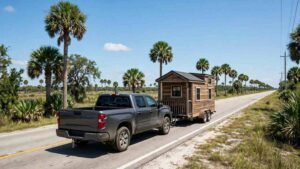
Towed trailers add significant stopping distance and reduce maneuverability compared to driving a truck alone. I drive noticeably slower and leave far more following distance the moment a tiny house is hitched up, regardless of how experienced I am behind the wheel.
- Reduce highway speed by 10–15 mph below the posted limit.
- Increase following distance to at least 5–6 seconds.
- Take wide, slow turns to account for trailer tracking.
- Anticipate sway from passing trucks and correct gradually, never abruptly.
- Use lower gears on downhill grades instead of riding the brakes.
Trailer sway, one of the more dangerous towing events, usually starts small and escalates if the driver overcorrects, so gradual steering input matters more than quick reaction.
Weather and Road Conditions to Watch For
Crosswinds, wet pavement, and steep grades all multiply the handling challenges of towing a tiny house. A loaded trailer presents a large flat side surface, which catches wind in a way a standard vehicle simply doesn’t.
Florida’s afternoon thunderstorms are a genuine towing hazard, since sudden heavy rain cuts visibility and traction at the same time. Checking a route’s elevation profile before a long tow helps you anticipate grades where trailer brakes will see the most work.
Common Towing Mistakes That Damage a Tiny House
Overloading beyond GVWR, using the wrong hitch type, and skipping brake controller calibration account for most towing-related damage I’ve seen reported. Each of these mistakes is fully preventable with the weight and equipment checks covered earlier in this guide.
Underestimating height clearance causes a different category of damage entirely, since bridges, gas station canopies, and tree branches don’t show up on a standard GPS route. Measuring total height from ground to roofline before any trip removes this risk almost completely.
Planning Your Towing Route
Route planning for a tiny house means checking bridge clearances, weigh station requirements, and permit zones before departure, not adjusting on the fly. Standard GPS apps don’t account for oversize load restrictions, which means a route that looks fine on a phone screen can lead directly into a legal or physical obstacle.
Specialized trucking route-planning tools account for height and width restrictions the way consumer GPS apps don’t, and I treat that extra step as mandatory for any multi-county tow.
Professional Towing Services vs. DIY Towing
Professional tiny house transport companies carry the insurance, equipment, and permitting experience that most individual owners don’t have access to. The decision between hiring a professional and towing it yourself usually comes down to distance, experience, and the value of the structure being moved.
| Factor | DIY Towing | Professional Transport |
| Cost | Lower upfront | $3–$8 per mile typical |
| Insurance coverage | Personal auto/umbrella only | Commercial cargo insurance |
| Permitting handled | Owner’s responsibility | Usually included |
| Best for | Short local moves, experienced towers | Long distance, first-time movers |
For a first long-distance move, the permitting and insurance coverage professional transport includes often outweighs the cost difference, particularly on a structure representing a major investment.
Maintenance Before and After Long Tows
Wheel bearings, brake pads, and tire tread wear faster under sustained towing loads than under normal driving conditions. I inspect bearings and brakes immediately after any tow longer than 200 miles, since heat buildup on long hauls accelerates wear in ways short trips don’t.
Re-torquing lug nuts after the first 50 miles of a new tow catches any connections that loosened during initial settling, a step too many owners skip entirely.
Conclusion
Towing a tiny house safely comes down to matching real weight to real truck capacity, the right hitch, and working brakes. Florida’s permit rules and licensing thresholds add one more layer most owners must plan around.
Every tiny house we build starts with an honest weight conversation, because that number shapes the entire ownership experience. We help you choose a build that tows safely with the truck you already have.
We’d rather walk you through these numbers before you buy than after. Reach out to Tiny Home Builders Florida and let’s get your towing setup right from day one.
Frequently Asked Questions
How much does it cost to tow a tiny house?
Professional tiny house transport typically costs $3 to $8 per mile, depending on distance, permits, and escort requirements. Shorter local moves run cheaper, while cross-state moves add permit and fuel costs.
Can I tow a tiny house with a half-ton truck?
Yes, but only for smaller tiny houses under roughly 10,000 pounds loaded weight. Larger or fully-equipped builds need a three-quarter-ton or one-ton truck for safe towing capacity.
Do I need a special license to tow a tiny house in Florida?
No, most tiny house towing combinations stay under Florida’s CDL weight threshold of 26,001 pounds. A standard Class E license covers the vast majority of tiny house tows.
How far can you safely tow a tiny house in one day?
Most experienced owners limit tiny house tows to 250–350 miles per day to manage driver fatigue and heat buildup in brakes and bearings. Longer trips should include scheduled rest and inspection stops.
What size truck do I need for a 30-foot tiny house?
A 30-foot tiny house usually requires a one-ton truck with at least 15,000 pounds of towing capacity. These larger builds often approach or exceed three-quarter-ton truck limits.
Is it legal to tow a tiny house on Florida highways?
Yes, with the correct permits when the trailer exceeds Florida’s standard width, height, or length limits. Most tiny houses need at least one oversize load permit before hitting the highway.
Should I hire a professional tiny house transport company?
Hiring a professional makes sense for long-distance moves or first-time towers unfamiliar with permitting. Professionals carry commercial insurance and handle permit logistics the average owner doesn’t have.