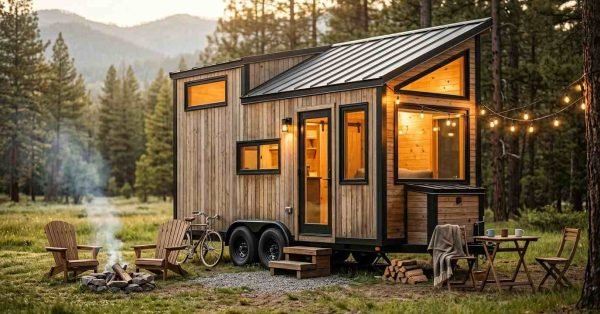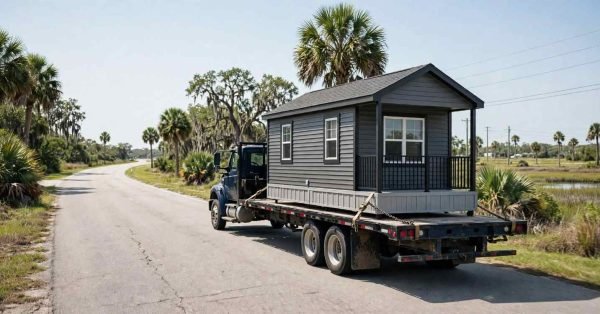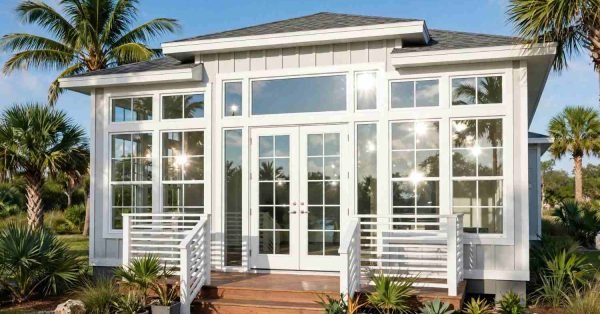

Park model homes are factory-built dwellings under 400 square feet, constructed to the ANSI A119.5 standard and designed for recreational or seasonal placement rather than full permanent foundations. I work with homeowners across Florida who confuse this category with mobile homes, RVs, and tiny houses constantly, and the confusion costs them time and money.
Choosing wrong here means fighting zoning boards, losing financing options, or buying a structure that cannot legally sit where you planned to put it.
This guide covers how each structure is legally defined, how their construction standards and codes differ, what size and durability look like side by side, what each option actually costs to buy and insure, and how to pick the right one for your Florida property.
What Is a Park Model Home?
A park model home is a factory-built structure under 400 square feet, built to the ANSI A119.5 standard and intended primarily for placement in a residential park or community rather than a standard subdivision lot.
I see these most often on Florida’s 55+ communities and seasonal resort properties, where residents want a real house feel without the footprint of a traditional build. They arrive on a single chassis, get set on piers or a simple foundation, and generally stay put once placed.
The ANSI A119.5 code governs electrical, plumbing, and structural requirements, and it’s a completely different rulebook from the one mobile homes follow.
What Is a Mobile Home (Manufactured Home)?
A manufactured home is a factory-built house constructed to the federal HUD Code, a standard that took effect in 1976 and still governs every manufactured home built today.
Unlike park model homes, manufactured homes run larger, often 600 to 2,500+ square feet, and they’re designed as full-time primary residences rather than seasonal units. HUD Code covers fire safety, structural design, energy efficiency, and transportability requirements that differ meaningfully from ANSI standards.
Florida counties generally zone manufactured homes separately from park models, which matters a lot once you start looking at placement options.
What Is an RV (Recreational Vehicle)?
A recreational vehicle is a motorized or towable unit built for temporary travel and recreation, certified under RVIA standards rather than a residential building code.
RVs are engineered for road use first and living space second. Insulation, plumbing, and electrical systems are built lighter than in a park model or manufactured home because the unit needs to move easily and often. Florida treats RVs as vehicles for registration purposes, which creates real restrictions if someone tries to live in one full-time on a residential lot.
What Is a Tiny House?
A tiny house is a small-footprint dwelling, typically under 500 square feet, built either on a foundation or on a trailer chassis for mobility.
Tiny houses split into two distinct categories that behave completely differently from a legal standpoint. A tiny house on wheels usually falls under RV certification standards or exists in a code gray area, while a tiny house on a permanent foundation gets treated like a standard site-built home under the International Residential Code. That distinction changes everything about financing, insurance, and where you’re allowed to put it.
Tiny House on Wheels vs. Foundation
A foundation-built tiny house qualifies for conventional mortgages in many cases. A wheeled tiny house almost never does, since lenders treat it closer to an RV than real property.
Size and Square Footage Differences
Park model homes top out around 400 square feet, manufactured homes commonly run 600 to 2,500+ square feet, RVs vary widely from 100 to 400 square feet, and tiny houses generally land between 100 and 500 square feet depending on design.
This table shows how the four categories compare on typical size range and layout style.
| Structure | Typical Size | Layout Style |
| Park Model Home | 320-400 sq ft | Single-level, cottage-style |
| Manufactured Home | 600-2,500+ sq ft | Multi-section, house-style |
| RV | 100-400 sq ft | Compact, travel-optimized |
| Tiny House | 100-500 sq ft | Open-concept, vertical storage |
Square footage alone doesn’t tell the full story, because the construction standard behind each number determines how that space actually performs.
Construction Standards and Building Codes
Four separate code bodies govern these structures, and each one sets a different bar for materials, safety systems, and structural requirements. Mixing them up is the single biggest mistake I see buyers make before they ever call a builder.
This table outlines which code applies to each structure type and what it primarily governs.
| Structure | Governing Code | Primary Focus |
| Park Model Home | ANSI A119.5 | Electrical, plumbing, structural |
| Manufactured Home | HUD Code | Fire safety, energy, structure |
| RV | RVIA Standards | Mobility, lightweight systems |
| Tiny House (foundation) | IRC (local) | Full residential building code |
ANSI vs. HUD vs. RVIA vs. IRC
The International Residential Code is the strictest of the four, since it treats the structure exactly like a conventional house, right down to foundation engineering and wind-load requirements specific to Florida’s hurricane zones.
Foundation, Placement, and Zoning Requirements

Florida zoning treats each structure type differently, and placement options narrow fast once you move outside designated parks or mobile home communities.
Getting this right before construction starts follows a fairly consistent sequence across Florida counties.
- Confirm the property’s zoning classification with the county planning department
- Check whether park models are permitted outside RV/park communities in that zone
- Verify manufactured home placement rules, including required skirting and tie-downs
- Confirm foundation-built tiny houses meet local minimum square footage ordinances
- Secure any variance or special use permit before ordering the structure
- Schedule county inspection at foundation and final completion stages
Skipping that sequence is how buyers end up with a structure they legally can’t keep where they put it.
Mobility and Transportability
Park model homes move rarely after initial placement, manufactured homes almost never relocate once set, RVs are built to move constantly, and wheeled tiny houses sit somewhere in between depending on how often the owner tows them.
Mobility and construction quality trade off against each other pretty directly. The lighter a structure is built for towing, the less insulation and structural mass it typically carries, which shows up later in how well it holds up.
Durability, Materials, and Build Quality
Construction quality varies more within these four categories than between them, but the baseline materials and framing methods differ enough to matter for anyone planning to live in a structure full-time rather than travel in it.
Framing, Insulation, Roofing Differences
Park model homes typically use residential-grade framing similar to manufactured homes, with 2×4 or 2×6 wall studs and shingled or metal roofing rated for wind exposure.
This table compares typical construction specifications across the four structure types.
| Structure | Wall Framing | Insulation R-Value | Roof Type |
| Park Model Home | 2×4/2×6 wood | R-11 to R-19 | Shingle/metal pitched |
| Manufactured Home | 2×4/2×6 wood | R-11 to R-22 | Shingle pitched |
| RV | Aluminum/fiberglass | R-3 to R-7 | Flat rubber membrane |
| Tiny House (foundation) | 2×4/2×6 wood | R-13 to R-21 | Standard residential |
RVs consistently show the lowest insulation values of the group, which explains why full-time RV living in Florida’s summer heat gets expensive fast on cooling costs.
Cost Comparison: Price, Financing, and Insurance
Park model homes typically run $50,000 to $100,000, manufactured homes range from $60,000 to $150,000+, RVs span $10,000 to $300,000 depending on class, and tiny houses cost $30,000 to $150,000 based on finish level.
This table breaks down typical purchase price and financing availability by structure type.
| Structure | Typical Price Range | Common Financing |
| Park Model Home | $50,000-$100,000 | Chattel loan, personal loan |
| Manufactured Home | $60,000-$150,000+ | FHA, VA, conventional (land-home) |
| RV | $10,000-$300,000 | RV loan |
| Tiny House (foundation) | $30,000-$150,000 | Conventional mortgage possible |
Insurance follows a similar pattern. Foundation-built structures qualify for standard homeowners policies more easily than anything on wheels, where insurers often require specialty RV or mobile home coverage instead.
Resale Value and Appreciation Potential
Foundation-built homes appreciate with the local Florida real estate market, while park models, manufactured homes, and RVs typically depreciate like vehicles rather than appreciating like real property.
A tiny house built on a permanent foundation is the only one of the four that reliably tracks local land value over time.
Lifestyle Fit: Space, Comfort, and Long-Term Living
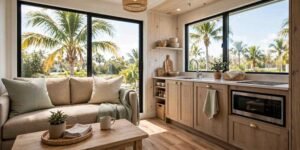
Day-to-day comfort comes down to insulation, square footage per occupant, and how permanent the setup feels, not just the listed size on a spec sheet.
Families planning full-time Florida living generally gravitate toward manufactured homes or foundation-built tiny houses, since both provide more stable year-round comfort than an RV’s lighter-weight systems.
How to Choose the Right Option for Your Needs in Florida

The right choice depends on how permanent you want the structure to be, what your budget covers, and whether your land is zoned for it.
This list breaks down which option typically fits which situation.
- Choose a park model home if you want a seasonal or 55+ community residence under 400 square feet
- Choose a manufactured home if you want a full-time primary residence with more square footage and standard financing options
- Choose an RV if mobility matters more than long-term comfort or insulation
- Choose a foundation-built tiny house if you want mortgage eligibility and land appreciation in a small footprint
Confirming your land’s zoning classification before ordering any structure saves the most time and money of any step in this process.
Conclusion
Park model homes, manufactured homes, RVs, and tiny houses each follow different codes, costs, and durability standards. Understanding these differences protects your investment before construction begins.
Florida’s zoning rules and climate demands make the right structural choice even more critical for long-term comfort. We’ve guided homeowners through this exact decision for years.
We build homes engineered for Florida’s standards, not just minimum code. Contact Tiny Home Builders Florida to start your project today.
Frequently Asked Questions
Is a park model home considered a mobile home?
No, a park model home follows ANSI A119.5 standards while mobile homes follow the HUD Code. They’re built to different specifications and classified separately by most Florida counties.
Can you live in a park model home year-round in Florida?
Yes, in many Florida communities zoned for park models, but some counties restrict year-round occupancy to seasonal use only. Check local zoning before purchasing.
Do park model homes need a building permit in Florida?
Yes, most Florida counties require placement permits and utility connection permits for park model homes. Requirements vary by county and community type.
What is the difference between a tiny house and a park model home?
Tiny houses can be built on foundations or wheels and often follow residential code, while park model homes always follow ANSI A119.5 and typically stay in designated parks. Financing and zoning rules differ significantly between the two.
How long do park model homes last compared to mobile homes?
Park model homes typically last 20 to 30 years with proper maintenance, similar to manufactured homes. Both fall short of the 50+ year lifespan typical of site-built construction.
Can an RV be classified as a park model home?
No, RVs are certified under RVIA standards for mobility, while park model homes follow ANSI A119.5 for semi-permanent placement. The two serve fundamentally different purposes despite similar sizes.
Are park model homes cheaper than manufactured homes?
Generally, yes, park model homes average $50,000 to $100,000 compared to $60,000 to $150,000+ for manufactured homes. Smaller square footage accounts for most of the price difference.