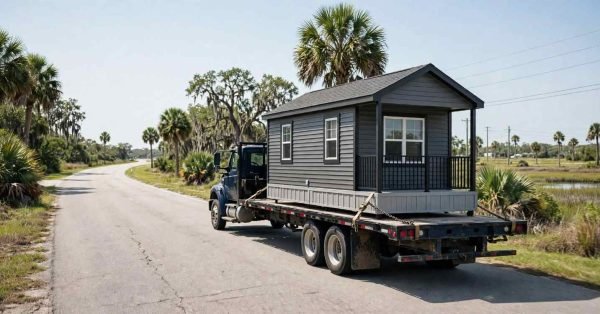
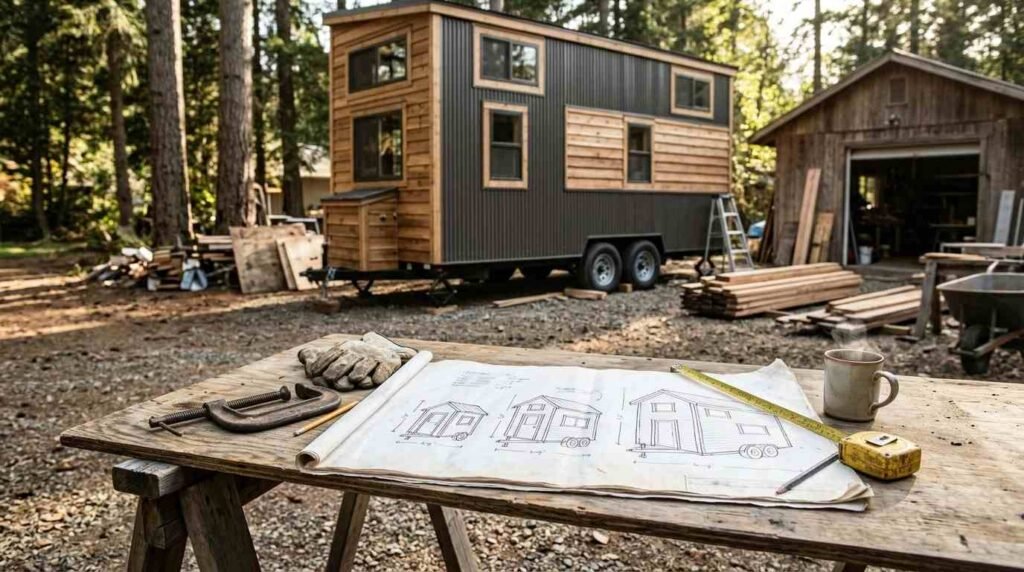
Tiny homes on wheels follow a strict set of dimension and weight rules that determine whether a build can legally travel on public roads without special permits. A THOW is a dwelling built on a trailer chassis, engineered to stay within federal and state road-legal limits for width, height, length, and weight. Buyers who skip this step often end up with a home they cannot legally tow or park.
Getting the size wrong costs more than a permit fee down the road. A trailer that exceeds road-legal limits forces expensive retrofits or route restrictions before move-in day.
This guide covers what qualifies as a THOW, the width and height limits that govern road legality, length and weight classes and how they scale, towing and axle requirements matched to those classes, Florida-specific DMV and zoning rules, and how size decisions affect layout, cost, and long-term livability.
What Counts as a Tiny Home on Wheels (THOW)?

A tiny home on wheels is a dwelling built on a flatbed or deck-over trailer chassis rather than a permanent foundation, designed to be towed by a vehicle rated for its weight class. The trailer itself is the structural foundation, which is what separates a THOW from a modular or manufactured home shipped to a lot.
This distinction matters because the trailer dictates every other dimension in the build. Width, height, and length all trace back to what a standard trailer chassis and public road system can legally accommodate.
THOW vs. Park Model vs. Tiny House on a Foundation
A park model RV is built to ANSI standards for seasonal recreational use and usually exceeds standard road width without a permit. A tiny house on a foundation has no trailer at all and follows regular residential building codes instead of road regulations. Each category answers a different question: can it move, and does it need to?
Standard THOW Width Classes Explained
The most important number in THOW sizing is 8.5 feet, the maximum width a trailer can travel at in most states without an oversize load permit. Anything built to this width class can legally travel on interstates and state highways without special escort or routing restrictions.
8.5 Feet Wide The Road-Legal Standard
Most production THOW builders target exactly 8.5 feet, or 102 inches, because it’s the federal standard width limit for commercial and noncommercial trailers under 49 CFR regulations. Staying at or under this width means a buyer can drive the home across state lines without applying for a single permit. It’s the width class that dominates the market for a reason: it removes an entire layer of bureaucracy from ownership.
Wide-Load THOWs (Over 8.5 Feet) and Permit Requirements
Builders who push past 8.5 feet for extra interior space move into wide-load territory, which triggers state-by-state oversize permit requirements, often with pilot car escorts and restricted travel hours. A wide-load THOW typically adds $150 to $400 per state crossed in permit fees, according to the Specialized Carriers & Rigging Association’s oversize transport guidance. Buyers planning frequent moves should weigh that recurring cost against the extra square footage.
Height Limits and Low-Clearance Hazards

The maximum legal height for a THOW traveling on U.S. roads is 13.5 feet measured from the ground to the highest point of the structure, including roof vents and AC units. This limit exists because it matches the clearance height of most highway overpasses and bridges nationwide.
The 13.5-Foot National Height Ceiling
Some states, including a handful in the western U.S., allow up to 14 feet, but 13.5 feet is the safe universal number builders design to since it works in every state without exception. Loft ceiling height, roof pitch, and even where the AC unit sits on the roof all get measured against this single ceiling. A THOW built even a few inches over this limit risks hitting a low bridge on a route that wasn’t checked in advance.
Length Classes From Micro THOWs to Full-Size Trailers
THOW length is measured from the trailer hitch to the rear bumper, and it’s the dimension with the widest range in the entire category, from compact 16-foot builds to extended 40-foot models. Length determines both livable square footage and which states require special trailer endorsements to tow.
Short-Bed THOWs (20 ft and Under)
A trailer at 20 feet or under typically delivers 120 to 160 square feet of interior floor space and stays light enough to tow with a mid-size SUV or half-ton truck. This class suits single occupants or couples prioritizing mobility and parking flexibility over square footage. Short-bed units also sidestep the stricter towing endorsements some states require above certain length thresholds.
Standard-Length THOWs (24-32 ft)
This length range is the market’s center of gravity, delivering 200 to 280 square feet while still towing behind a properly rated three-quarter-ton or one-ton pickup. Most full-time dwellers land in this class because it balances livable space against towing practicality. It’s also the range where a full bathroom, separate bedroom loft, and real kitchen all fit without heavy compromise.
Extended-Length THOWs (34-40 ft)
Trailers in this range approach 320 to 400 square feet but cross into commercial-grade towing territory, often requiring a one-ton dually truck or larger. Several states classify trailers over 35 feet differently for licensing purposes, which can mean a non-commercial driver’s license no longer covers the combination. Buyers considering this class need to check their home state’s combined-length licensing rule before ordering a build this long.
Weight Classes and GVWR Explained
Gross Vehicle Weight Rating, or GVWR, is the maximum total weight a trailer and its contents are rated to carry safely, and it’s the single number that determines what truck can legally tow a finished THOW. Builders and buyers both need this figure before a tow vehicle gets chosen, not after.
Dry Weight vs. GVWR vs. Payload Capacity
Dry weight is what the trailer and structure weigh with zero contents, water, or occupants. GVWR is the manufacturer’s hard ceiling for total weight once everything is loaded. Payload capacity is simply the gap between those two numbers, the room left over for furniture, appliances, water tanks, and belongings. A 2024 trailer manufacturing survey found that THOW builders underestimate finished weight by an average of 8-12% when they calculate based on dry weight alone instead of realistic loaded payload, according to the RV Industry Association’s chassis reporting standards. That gap is exactly why a trailer rated for the structure alone often can’t legally carry a full water tank and a loaded pantry on moving day.
Trailer Axle Configurations by Weight Class
Axle count directly correlates with how much weight a THOW trailer can carry, which is why heavier builds in longer length classes almost always ride on more axles than compact short-bed units.
Single-Axle, Tandem-Axle, and Triple-Axle Trailers
A single-axle trailer typically caps out around 3,500 to 7,000 pounds GVWR and suits only the smallest, lightest builds. Tandem-axle, or dual-axle, trailers handle the 10,000 to 14,000 pound range and cover most standard-length THOWs on the market today. Triple-axle configurations exist for extended-length, heavier-material builds pushing past 15,000 pounds GVWR, and they also improve stability and reduce bounce on highway travel at those weights.
Towing Requirements by Size and Weight Class
The tow vehicle has to match the trailer’s fully loaded GVWR, not its dry weight, which means the same THOW can require a completely different truck depending on how it’s packed for the move.
Matching Tow Vehicle Class to THOW Weight
A half-ton truck comfortably tows trailers up to roughly 7,500 pounds loaded. Three-quarter-ton and one-ton trucks extend that range to 12,000 and 16,000-plus pounds respectively, which covers most standard and extended-length THOWs. Exceeding a truck’s rated towing capacity isn’t just unsafe, it also voids insurance coverage in the event of an accident during transport.
Florida DMV and DOT Regulations for THOW Size
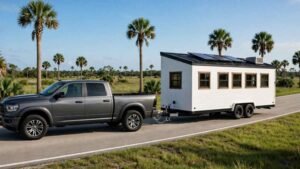
Florida treats a THOW’s registration path differently depending on whether it’s titled as a travel trailer or a park model, and that classification hinges directly on the dimensions covered earlier in this guide.
Registration and Titling Thresholds in Florida
The Florida Department of Highway Safety and Motor Vehicles requires any trailer over 2,500 pounds to be titled, according to Florida’s official DHSMV titling requirements. Most finished THOWs well exceed this threshold, which means nearly every buyer in the state will go through a formal titling process rather than a simple registration. The classification chosen at titling, travel trailer versus park model, also affects which Florida counties will approve it for long-term residential parking.
Florida Oversize Load Permits for Wide or Long THOWs
Florida’s Department of Transportation requires an oversize load permit for any trailer exceeding 8.5 feet in width or 13.5 feet in height, matching the national standard covered earlier. Permits in Florida are issued per trip and typically require advance route approval, especially for loads crossing bridges with posted clearance limits. A buyer planning to transport a wide-load THOW into Florida should apply for this permit before the delivery date is locked in, since processing can take several business days.
How Dimensions Shape Interior Floor Plan Options
Every dimension decided earlier in this guide, width, height, and length, directly constrains what a floor plan can physically include, which is why layout planning always comes after sizing, never before.
Loft Height Constraints Tied to Overall Height Limits
A sleeping loft needs roughly 3 to 4 feet of headroom to be usable without constant stooping, and that space has to come out of the same 13.5-foot height budget as the main living area ceiling below it. Builders working within the standard height ceiling often compromise by lowering main-floor ceiling height slightly to gain loft clearance. This tradeoff is one of the most common points of dissatisfaction among first-time THOW owners who didn’t see a full-scale mockup before signing off on a design.
Choosing the Right Size Class for Your Lifestyle
The right size class comes down to occupant count and lifestyle first, towing convenience second, since a home too small for daily life defeats the purpose regardless of how easy it is to move.
Sizing for Singles, Couples, and Families
A single occupant generally lives comfortably in a short-bed class THOW under 160 square feet. Couples tend to need the breathing room of a standard-length build, particularly if both partners work from home at different times of day. Families with children almost always require extended-length classes or even multiple connected units, since separate sleeping zones become a functional necessity rather than a luxury.
How Size and Weight Class Affect Build Cost
Every additional foot of trailer length adds cost on three fronts at once: more trailer steel, more framing material, and more finished square footage to insulate, wire, and plumb.
Builders typically price THOW construction per square foot, which means a jump from a standard-length class to an extended-length class doesn’t scale linearly, it compounds once heavier axle configurations and reinforced framing enter the picture. A buyer comparing quotes across size classes should expect the price-per-square-foot to rise, not stay flat, as total length and weight class increase.
Florida Zoning, Lot, and Parking Considerations by THOW Size
Where a finished THOW can legally sit long-term in Florida depends heavily on its titled classification and physical footprint, and this varies significantly by county and municipality.
HOA and County Size Restrictions Across Florida Markets
Many Florida counties regulate tiny homes on wheels under RV parking ordinances rather than residential dwelling codes, which can cap how many consecutive days a unit sits on a single-family lot. HOA agreements frequently add stricter limits than county code, sometimes banning any trailer-based dwelling regardless of size or titling status. Buyers should confirm local zoning and HOA rules for their specific size class before finalizing a floor plan, since a larger unit that violates setback or footprint rules can become unplaceable on an otherwise suitable lot.
Materials and Construction Choices That Affect Weight
Every material decision in a THOW build carries a weight cost that compounds against the trailer’s GVWR ceiling, which means material selection and size class planning have to happen together, not separately.
Steel-frame construction adds durability but weighs considerably more than wood-frame alternatives, often pushing a mid-size build into the next axle configuration up. Standard drywall weighs multiple times more than lightweight composite wall panels across an entire interior, which is why many builders targeting lighter weight classes switch wall materials before they switch trailer length.
Common Sizing Mistakes That Cause Legal or Towing Problems
Most THOW sizing problems trace back to one of a handful of repeatable mistakes that show up again and again across the buying process.
Buyers frequently calculate towing capacity against dry weight instead of realistic loaded GVWR, which leaves them under-trucked on moving day. Others skip checking their home state’s combined-length licensing threshold before ordering an extended-length build, only to discover their standard license doesn’t cover the finished rig. A third common mistake is finalizing a floor plan before confirming the trailer’s actual width and height ratings, which forces costly redesigns mid-build.
How to Verify THOW Dimensions and Weight Before You Buy
Before signing any build contract, a buyer should request the trailer manufacturer’s certified weight rating plate specs, not just the builder’s marketing brochure numbers.
Cross-checking the certified GVWR, axle rating, and dry weight against the finished floor plan’s estimated loaded weight catches most sizing problems before they become expensive. Requesting a written confirmation of final exterior dimensions, width, height, and length, protects against surprises at delivery and registration. Buyers working with an experienced local builder gain a real advantage here, since a builder familiar with Florida’s specific titling and road requirements can flag sizing issues long before a trailer ever reaches the road.
Conclusion
THOW sizing comes down to width, height, length, and weight working together inside legal and towing limits. Understanding these classes helps buyers avoid costly redesigns, permit surprises, and towing mismatches. We at Tiny Home Builders Florida help you plan every dimension right from day one.
Frequently Asked Questions
What is the maximum legal width for a tiny home on wheels?
The maximum road-legal width without a special permit is 8.5 feet in most states. Builders target this width to avoid oversize load permits and route restrictions. Exceeding it requires state-by-state permitting.
How tall can a THOW be and still travel legally?
A THOW can travel legally up to 13.5 feet tall in all states. Some western states allow up to 14 feet. Builders design to the lower number for nationwide compatibility.
What is the difference between dry weight and GVWR?
Dry weight is the trailer’s weight with nothing loaded, while GVWR is the maximum total weight allowed once loaded. The gap between them is the payload capacity. Confusing the two often leads to under-trucking.
Do I need a special license to tow a tiny home in Florida?
Florida doesn’t require a special license for most standard THOWs under typical weight thresholds. Extended-length or heavier trailers may require a different vehicle class. Checking combined weight and length against state thresholds is essential first.
What size tiny home qualifies as road-legal without a permit?
A THOW at or under 8.5 feet wide and 13.5 feet tall qualifies as road-legal without an oversize permit. Length alone doesn’t typically require a permit. Weight still must match the tow vehicle’s rated capacity.
How much does trailer size affect tiny home build cost?
Larger size classes increase cost on multiple fronts, including materials, labor, and heavier axle configurations. Cost per square foot tends to rise, not stay flat, as size increases. Weight class upgrades add further cost beyond square footage alone.
Can I register a THOW as an RV in Florida?
Florida allows THOWs to be titled as travel trailers in many cases, depending on construction and certification. This classification affects parking and zoning rules. Confirming the correct classification before purchase avoids registration issues later.